From the journal of Steven H. Cullinane... 2003 May 1-15

Thursday, May 15, 2003

The Only Pretty Ring Time

On May 14 five years ago, the night Sinatra died, the Pennsylvania (State of Grace) lottery evening number was 256:  see my note, Symmetries, of April 2, 2003.

On May 14 this year, the Pennsylvania lottery evening number was 147.  Having, through meditation, perhaps established some sort of minor covenant with whatever supernatural lottery powers may exist, this afternoon I sought the significance of this number in Q's 1939 edition of the Oxford Book of English Verse.  It is the number of "It was a Lover and his Lass," a song lyric by William Shakespeare.  The song includes the following lines:

In the spring time,
    the only pretty ring time,
When birds do sing,
    Hey ding a ding, ding;
Sweet lovers love the spring.

For the Sinatra connection, see
Metaphysics for Tina.

The selection of Q's book for consultation was suggested by the home page of Simon Nickerson at Jesus College, Cambridge University, and by the dedication page of Q's 1925 Oxford Book of English Prose, which names Nickerson's school.

Ian Lee on the communion of saints and the association of ideas:

"The association is the idea."

For translation of the Greek phrase in Q's 1925 dedication, see

Greek and Roman Grammarians
on Motion Verbs and Place Adverbials

Malcolm D. Hyman
Harvard University
January 4, 2003

3:33 pm


Thursday, May 15, 2003

Birthday Present

Today is the birthday of Emile Mathieu.
Here is a present.

1:23 pm


Thursday, May 15, 2003

Well Done

"So tell me about the matrix reloaded... and what it's like to finish a job well done."

-- Weblog entry by Harvard student, May 15, 2003

The matrix reloaded: 

See chapter VII, "Composition," in Chinese Calligraphy: An Introduction to Its Aesthetic and Technique, by Chiang Yee, Harvard University Press, first published April 21st, 1938.

A job well done:

"The Best is Yet to Come"
-- Epitaph of Francis Albert Sinatra

12:00 pm


Wednesday, May 14, 2003

Common Sense

On the mathematician Kolmogorov:

"It turns out that he DID prove one basic theorem that I take for granted, that a compact hausdorff space is determined by its ring of continuous functions (this ring being considered without any topology) -- basic discoveries like this are the ones most likely to have their origins obscured, for they eventually come to be seen as mere common sense, and not even a theorem."

-- Richard Cudney, Harvard '03, writing at Xanga.com as rcudney on May 14, 2003

That this theorem is Kolmogorov's is news to me.

See

The above references establish that Gelfand is usually cited as the source of the theorem Cudney discusses.  Gelfand was a student of Kolmogorov's in the 1930's, so who discovered what when may be a touchy question in this case.  A reference that seems relevant: I. M. Gelfand and A. Kolmogoroff, "On rings of continuous functions on topological spaces," Doklady Akad. Nauk SSSR 22 (1939), 11-15.  This is cited by Gillman and Jerison in the classic Rings of Continuous Functions.

There ARE some references that indicate Kolmogorov may have done some work of his own in this area.  See here ("quite a few duality theorems... including those of Banaschewski, Morita, Gel'fand-Kolmogorov and Gel'fand-Naimark") and here  ("the classical theorems of M. H. Stone, Gelfand & Kolmogorov").

Any other references to Kolmogorov's work in this area would be of interest.

Naturally, any discussion of this area should include a reference to the pioneering work of M. H. Stone.  I recommend the autobiographical article on Stone in McGraw-Hill Modern Men of Science, Volume II, 1968.

2:00 pm

Comments on this post:

Someday, sir, when I've finished the memoir and run dry of rants, I will come back here and follow all your links and refresh and extend my math awareness.  Each time I take the time to really get into one of your blogs, it is rewarding.

Posted 5/14/2003 at 4:26 pm by SuSu


Tuesday, May 13, 2003

Cubist Catechism

For the birthday of Georges Braque

From A Wrinkle in Time, by Madeleine L'Engle:

"Now we will tesser, we will wrinkle again. Do you understand?"

"No," Meg said flatly....

"Oh, dear," Meg sighed. "I guess I am a moron. I just don't get it."

"That is because you think of space only in three dimensions," Mrs. Whatsit told her....

Meg sighed. "Just explain it to me."

"Okay," Charles said. "What is the first dimension?"

"Well -- a line."

"Okay. And the second dimension?"

"Well, you'd square the line. A flat square would be in the second dimension."

"And the third?"

"Well, you'd square the second dimension. Then the square wouldn't be flat any more. It would have a bottom, and sides, and a top."

"And the fourth?"

"Well, I guess if you want to put it into mathematical terms you'd square the square. But you can't take a pencil and draw it the way you can the first three."


Braque


12:06 pm

Comments on this post:

Ah! That is perfect! I was describing that *exact passage* to somebody just the other day. That was my first contact with the concept of "dimensions", and L'Engle captured it very well. I still use her description to straighten out the idea of dimensions greater than three in my own head. It got me through Linear Algebra in university; people still look at me funny when I say I enjoyed it.

I've never seen an illustration like that, though. That is a bit wild.

Posted 5/13/2003 at 2:29 pm by iride

So, you CAN, apparently, pencil it out, but... you still have to think those other two dimensions.  I wanna SEE one.

Posted 5/14/2003 at 4:24 pm by SuSu

Click here for the best way I know to see a tesseract.

Posted 5/14/2003 at 7:12 pm by m759


Tuesday, May 13, 2003

Operation Playmate:

11:01 AM

On this date in 1938, Louis Armstrong and his orchestra recorded "When the Saints Go Marching In."

On this date in 1961, Saint Gary Cooper died.

From my Jan. 2, 2003, entry:

Faces of the Twentieth Century:
The Harvest Continues

"I walk, I lift up, I lift up heart, eyes,
Down all that glory in the heavens
    to glean our Saviour;
And, éyes, héart, what looks, what lips
    yet gave you a
Rapturous love's greeting of realer,
    of rounder replies?"

— Gerard Manley Hopkins,
   "Hurrahing in Harvest"

Mary Brian

Joe Foss

"Cowboy, take me away.
Fly this girl as high as you can
into the wild blue."

The Dixie Chicks

From my March 31, 2003, entry:

"During the Gulf War, Playboy magazine's celebrated Centerfolds reached out to U.S. military men and women... with their 'Operation Playmate' project....

Now, in light of the war in Iraq, 'Operation Playmate' has returned."

Entertainment Weekly, May 2, 2003:

Perhaps, in heaven, Dixie Chick Natalie "Mattress Dancing" Maines will provide terpsichorean instruction. 

Etymology: Latin Terpsichor,
from Greek Terpsikhor,
from feminine of terpsikhoros,
dance-loving : terpein, to delight
+ khoros, dance.

See, too, my entry for Beltane (May 1), the day that death claimed the 13th Episcopal bishop of New York City.

All of these events are not without interest, but it is not easy to fit them into one coherent story, as Robert Penn Warren once requested:

"The name of the story will be Time,
But you must not pronounce its name.
Tell me a story of deep delight."

It is perhaps relevant that, as T. S. Eliot well knew, there can be no dance except in time, and that the time of my May 1 entry is 5:13, today's date in another guise.  To paraphrase an Eliot line, 

"Hurry up please, it's 5/13."

11:01 am


Monday, May 12, 2003

The Tony Nominations

Dannie Abse quoting Robert Penn Warren:

"The name of the story will be Time,
But you must not pronounce its name.
Tell me a story of deep delight."

 Dannie Abse

Abse deserves a Tony Smith award¹ for his play Pythagoras.

Frank Rich on Bush's Top Gun speech:

"Only hours before President Bush's prime-time speech came news of what Variety headlined on Page 1 as 'Regime Change' in Hollywood — the departure of the [West Wing] creator, the writer Aaron Sorkin."

 George W. Bush

President Bush deserves a Tony Smith award² for his performance aboard the aircraft carrier Abraham Lincoln.

 Madeleine L'Engle on the religion of Cubism:

"There is such a thing as a tesseract."

 Madeleine L'Engle

L'Engle, former librarian at the Cathedral of St. John the Divine in New York City, deserves a Tony Smith award³ for insisting on the existence of the tesseract, or 4-dimensional cube, as an object of conceptual art.

L'Engle is perhaps the best defender of the religious, or "story," theory of truth, as opposed to the "diamond" theory of truth. (See my earlier May 12 entry, "Death and Truth," which deals with the bishop of L'Engle's cathedral.)

¹ See Tony Smith on mathematics.

² See Tony Smith on foreign policy.

³ See Tony Smith on conceptual art.

6:10 pm


Monday, May 12, 2003

Epiphany 1941:
Why We Fought

Jan. 6, 1941

Hepburn's father was disgusted and heartsick over her decision to become an actor. He thought it was a silly profession, closely allied to street walking.
-- Heather Wilgar

Not the way she did it.
-- S. H. Cullinane

Hepburn is 96 today.

2:40 pm


Monday, May 12, 2003

Death and Truth

Material related to my May 9, 2003, notes:

  1. Pilate, Truth, and Friday the Thirteenth
  2. The Diamond Theory of Truth
  3. Understanding
3:33 am


Sunday, May 11, 2003

Day of the Mother Ship:

A Close Encounter of the Third Level

Today is also the feast day of Saint Zenna Henderson, who was born on All Saints' Day, 1917.   The Adherents.com website says she was a Mormon, but the printed reference work Contemporary Authors (written when she was still alive and could defend herself against any accusation of Mormonism) says she was a Methodist.  Maybe she was just one of The People -- i.e., a Person.

"The concept of a person, which we find so familiar in its application to human beings, cannot be clearly and sharply expressed by any word in the vocabulary of Plato and Aristotle; it was wrought with the hammer and anvil* of theological disputes about the Trinity and the Person of Christ."

-- Peter Geach, The Virtues, Cambridge U. Press, 1977, p. 75

See also Terpsichore and the Trinity.


* For a use of this phrase suited to Mental Health Month, see The Prisoner, Episode Ten.  See, too, Inaugural Address.

4:15 pm


Friday, May 09, 2003

ART WARS:
The Religion of Cubism

In the dome of the Capitol at Washington, DC, a painting depicts The Apotheosis of Washington.  Personally, I prefer the following pair of pictures, which might be titled Apotheosis of the Cube.

logo

Die

A New York Times article says Tony Smith's instructions for fabricating Die were as follows:

"a six-foot cube of quarter-inch hot-rolled steel with diagonal internal bracing."

The transparent cube in the upper picture above shows the internal diagonals.  The fact that there are four of these may be used to demonstrate the isomorphism of the group of rotations of the cube with the group of permutations on an arbitrary set of four elements.  For deeper results, see Diamond Theory.

For an explanation of why our current president might feel that the cube deserves an apotheosis, see the previous entry, "The Rhetoric of Power."

See, too, Nabokov's Transparent Things:

"Its ultimate vision was the incandescence of a book or a box grown completely transparent and hollow.  This is, I believe, it: not the crude anguish of physical death but the incomparable pangs of the mysterious mental maneuver needed to pass from one state of being to another.  Easy, you know, does it, son."

7:20 pm


Friday, May 09, 2003

ART WARS

The Rhetoric of Power:
A meditation for Mental Health Month

From "Secondary Structures," by Tom Moody, Sculpture Magazine, June 2000:

"By the early ’90s, the perception of Minimalism as a 'pure' art untouched by history lay in tatters. The coup de grâce against the movement came not from an artwork, however, but from a text. Shortly after the removal of Richard Serra’s Tilted Arc from New York City’s Federal Plaza, Harvard art historian Anna Chave published 'Minimalism and the Rhetoric of Power' (Arts Magazine, January 1990), a rousing attack on the boys’ club that stops just short of a full-blown ad hominem rant. Analyzing artworks (Walter de Maria’s aluminum swastika, Morris’s 'carceral images,' Flavin’s phallic 'hot rods'), critical vocabulary (Morris’s use of 'intimacy' as a negative, Judd’s incantatory use of the word 'powerful'), even titles (Frank Stella’s National Socialist-tinged Arbeit Macht Frei and Reichstag), Chave highlights the disturbing undercurrents of hypermasculinity and social control beneath Minimalism’s bland exterior.  Seeing it through the eyes of the ordinary viewer, she concludes that 'what [most] disturbs [the public at large] about Minimalist art may be what disturbs them about their own lives and times, as the face it projects is society’s blankest, steeliest face; the impersonal face of technology, industry and commerce; the unyielding face of the father: a face that is usually far more attractively masked.' ”

From Maureen Dowd's New York Times column of June 9, 2002: 

"The shape of the government is not as important as the policy of the government. If he makes the policy aggressive and pre-emptive, the president can conduct the war on terror from the National Gallery of Art."

From the New York Times
Friday, May 2, 2003:

The National Gallery of Art in Washington has just acquired Tony Smith's first steel sculpture: "Die," created in 1962 and fabricated in 1968.

"It's a seminal icon of postwar American art," said Earl A. Powell III, director of the National Gallery.


Die (Tony Smith)

Bishop Moore


From a New York Times obituary,
Friday, May 2, 2003:

Bishop Dies

by Ari L. Goldman

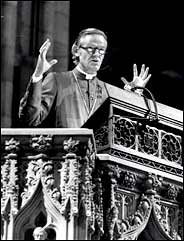
Paul Moore Jr., the retired Episcopal bishop of New York who for more than a decade was the most formidable liberal Christian voice in the city, died yesterday at home in Greenwich Village. He was 83....

Bishop Moore argued for his agenda in the most Christian of terms, refusing to cede Biblical language to the Christian right. Although he retired as bishop in 1989, he continued to speak out, taking to the pulpit of his former church as recently as March 24, even as illness overtook him, to protest the war in Iraq.

"It appears we have two types of religion here," the bishop said, aiming his sharpest barbs at President Bush. "One is a solitary Texas politician who says, `I talk to Jesus, and I am right.' The other involves millions of people of all faiths who disagree."

He added: "I think it is terrifying. I believe it will lead to a terrible crack in the whole culture as we have come to know it."....

[In reference to another question] Bishop Moore later acknowledged that his rhetoric was strong, but added, "In this city you have to speak strongly to be heard."

Paul Moore's early life does not immediately suggest an affinity for the kinds of social issues that he would later champion.... His grandfather was one of the founders of Bankers Trust. His father was a good friend of Senator Prescott Bush, whose son, George H. W. Bush, and grandson, George W. Bush, would become United States presidents.

Related material (update of May 12, 2003):

  1. Pilate, Truth, and Friday the Thirteenth
  2. The Diamond Theory of Truth
  3. Understanding

Question:

Which of the two theories of truth in reading (2) above is exemplified by Moore's March 24 remarks?

6:30 pm


Friday, May 09, 2003

ART WARS:
Invitation to the Dance

While checking the claim of art historian Anna Chave that "the veil is an age-old metaphor used from Plato through Hegel and Heidegger for the concept of truth as aletheia or unveiling,"  I came across the following essay:

"Taking the Veil," by Jessica Kardon.

Kardon writes very well.  A related essay I particularly like is

"Invitation to the Dance."

Today's entry on Kardon is part of my "ART WARS" series of journal notes.  This title began partly as a joke, but it seems rather appropriate in light of Anna Chave's claim that minimalism in the 1960's was part of the "rhetoric of power."  See my later entry today on Tony Smith at the National Gallery.

If we are in a war of art,

the essays of Jessica Kardon

are a powerful weapon.

4:44 pm


Friday, May 02, 2003

ART WARS:

The following flashback to March 2002 seems a suitable entry for May, which is Mental Health Month.

Zen and Language Games

by Steven H. Cullinane
on March First, 2002

Two Experts Speak --

A Jew on Language Games

From On Certainty, by Ludwig Wittgenstein (Oxford, Basil Blackwell, 1969):

#508: What can I rely on?
#509: I really want to say that a language game is only possible if one trusts something. (I did not say "can trust something").
-- Quoted by Hilary Putnam in Renewing Philosophy, Chapter 8 (Harvard University Press, 1992)

An Arab on Deconstruction

From "Deconstructing Postmodernism," by Ziauddin Sardar, at the website "The Free Arab Voice":

Doubt, the perpetual and perennial condition of postmodernism, is best described by the motto of the cult television series The X-files: ‘Trust no One’....

Deconstruction – the methodology of discursive analysis – is the norm of postmodernism. Everything has to be deconstructed. But once deconstruction has reached its natural conclusion, we are left with a grand void: there is nothing, but nothing, that can remotely provide us with meaning, with a sense of direction, with a scale to distinguish good from evil.

Those who, having reviewed a thousand years of lies by Jews, Arabs, and Christians, are sick of language games, and who are also offended by the recent skillful deconstruction of the World Trade Center, may find some religious solace in the philosophy of Zen.

Though truth may be very hard to find in the pages of most books, the page numbers are generally reliable. This leads to the following Zen meditations.

From a review of the film "The Terminator":

Some like to see Sarah as a sort of Mother of God, and her son as the saviour in a holy context. John Connor, J.C. , but these initials are also those of the director, so make up your own mind.
-- http://www.geocities.com/
   hackettweb2/terminator.html

From a journal note on religion, science, and the meaning of life written in 1998 on the day after Sinatra died and the Pennsylvania lottery number came up "256":

"What is 256 about?"
-- S. H. Cullinane

From Michael Crichton's Rising Sun (Ballantine paperback, 1993) --
John Connor (aka J. C.) offers the following metaphysical comment on the page number that appears above his words (256
):

"It seems to be."
"Is your investigation finished?"
"For all practical purposes, yes," Connor said.

Connor is correct. The number 256 does indeed seem to be, and indeed it seemed to be again only yesterday evening, when the Pennsylvania lottery again made a metaphysical statement.

Our Zen meditation on the trustworthiness of page numbers concludes with another passage from Rising Sun, this time on page 373:

Connor sighed.
"The clock isn't moving."

Here J. C. offers another trenchant comment on his current page number.

The metaphysical significance of 373, "the eternal in the temporal," is also discussed in the Buddhist classic A Flag for Sunrise, by Robert Stone (Knopf hardcover, 1981)... on, of course, page 373.

4:15 pm


Thursday, May 01, 2003

Rhymes with Puck

Readings for May Day, also known as Beltane.

  I. The Playboy of the Western World

 II.  Beltane

III.  A is for Art

Bell/Taine

In 1993, The Mathematical Association of America published Constance Reid's

THE SEARCH FOR E. T. BELL
also known as John Taine.

This is a biography of Eric Temple Bell, a mathematician and writer on mathematics, who also wrote fiction under the name John Taine.

On page 194, Reid records a question Bell's son asked as a child.  Passing a church and seeing a cross on the steeple, he inquired, "Why is the plus up there?"

For an answer that makes some sort of sense

  • in the context of Part II above, and
  • in the context of last month's "Math Awareness Month" theme, mathematics and art,

consider the phrase "A is for Art," so aptly illustrated by Olivia Newton-John in "Wrestling Pablo Picasso,"  then examine the photograph of ballerina Margaret "Puck" Petit on page 195 of Reid's book.  Puck, as the mother of Leslie Caron (see Terpsichore's Birthday), clearly deserves an A+.

5:13 pm

Comments on this post:

I had heard of Bell, but not Taine.  How wildly synchronistic all of that is.  I love coming here, must remember to let myself do so more often.

Posted 5/1/2003 at 5:26 pm by SuSu

you are something I don't understand, and I'm so glad I don't.

Posted 5/1/2003 at 5:29 pm by BabalonTheBride