|
Friday, March 14, 2003 |
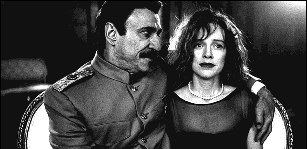
The Producers, Part Deux: The Consumers From THE NEW YORK TIMES Sidney Lippman, the composer and songwriter who wrote the music for "A — You're Adorable," died on Tuesday, March 11, 2003, in New Jersey. He was 89. He teamed up with lyricists Buddy Kaye and Fred Wise to write "A — You're Adorable (The Alphabet Song)" which became a No. 1 hit in 1949 as an RCA Victor recording with Perry Como and the Fontane Sisters. See also my Tuesday, March 11, entry, and my entry from 2001, Random Thoughts for St. Patrick's Eve. The illustration above, a tribute to Meg Ryan on Einstein's birthday, may serve as a counterpoint to the "Producers" entry of March 11, the date of Lippman's death. The St. Patrick's Eve note contains a rather different meditation on the letter "A." See too The Alphabet Versus the Goddess, an intriguing speculation by Leonard Shlain, who claims to show that "patriarchy and misogyny have moved contrapuntually to goddess veneration." Well, maybe not quite yet; but blessed are the peacemakers.
|
|
Thursday, March 13, 2003 |
ART WARS: From The New Yorker, issue of March 17, 2003, Clive James on Aldous Huxley: “The Perennial Philosophy, his 1945 book compounding all the positive thoughts of West and East into a tutti-frutti of moral uplift, was the equivalent, in its day, of It Takes a Village: there was nothing in it to object to, and that, of course, was the objection." For a cultural artifact that is less questionably perennial, see Huxley's story "Young Archimedes." Plato's Diamond in the Meno Plato's Diamond Revisited "... and he proceeded to prove the theorem of Pythagoras -- not in Euclid's way, but by the simpler and more satisfying method which was, in all probability, employed by Pythagoras himself.... Sir Thomas L. Heath, in his commentary on Euclid I.47, asks how Pythagoreans discovered the Pythagorean theorem and the irrationality of the diagonal of a unit square. His answer? Plato's diamond. Other sites on the alleged Colorful diagrams at Cut-the-Knot For further details of Huxley's story, see Part I, by Robert P. Langlands, from a lecture series at the Institute for Advanced Study, Princeton. From the New Yorker Contributors page for St. Patrick's Day, 2003:
"Clive James (Books, p. 143) has a new collection, As of This Writing: The Essential Essays, 1968-2002, which will be published in June."
See also my entry "The Boys from Uruguay" and the later entry "Lichtung!" on the Deutsche Schule Montevideo in Uruguay. |
|
Thursday, March 13, 2003 |
Death Knell In memory of Howard Fast, novelist and Jewish former Communist, who died yesterday, a quotation:
"For many of us, the geometry course sounded the death knell for our progress — and interest — in mathematics." — "Shape and Space in Geometry" © 1997-2003 Annenberg/CPB. All rights reserved. See also
5:24 am Comments on this post:
|
|
Thursday, March 13, 2003 |
Birthday Song Today is the birthday of the late Jewish media magnate and art collector Walter H. Annenberg, whose name appears on a website that includes the following text:
"Making quilt blocks is an excellent way to explore symmetry. A quilt block is made of 16 smaller squares. Each small square consists of two triangles. Study this example of a quilt block:
This block has a certain symmetry. The right half is a mirror image of the left, and the top half is a mirror of the bottom." © 1997-2003 Annenberg/CPB. All rights reserved. Symmetries of patterns such as the above are the subject of my 1976 monograph " Diamond Theory," which also deals with "shape and space in geometry," but in a much more sophisticated way. For more on Annenberg, see my previous entry, "Daimon Theory." For more on the historical significance of March 13, see Neil Sedaka, who also has a birthday today, in " Jews in the News." Sedaka is, of course, noted for the hit tune "Happy Birthday, Sweet Sixteen," our site music for today. See also Geometry for Jews and related entries. For the phrase "diamond theory" in a religious and philosophical context, see "It's quarter to three...." — Frank Sinatra |
|
Wednesday, March 12, 2003 |
Daimon Theory Today is allegedly the anniversary of the canonization, in 1622, of two rather important members of the Society of Jesus (Jesuits): Ignatius Loyola... Francis Xavier... We can thank (or blame) a Jesuit (Gerard Manley Hopkins) for the poetic phrase "immortal diamond." He may have been influenced by Plato, who has Socrates using a diamond figure in an argument for the immortality of the soul. Confusingly, Socrates also talked about his "daimon" (pronounced dye-moan). Combining these similar-sounding concepts, we have Doctor Stephen A. Diamond writing about daimons — a choice of author and topic that neatly combines the strategic intelligence of Loyola with the strategic stupidity of Xavier. The cover illustration is perhaps not of Dr. Diamond himself. A link between diamond theory and daimon theory is furnished by the charitable legacy of the non-practicing Jew Walter Annenberg. For Annenberg and diamond theory, see this site on the elementary geometry of quilt blocks, which credits the Annenberg Foundation for support. For Annenberg and daimon theory, see this site on Socrates, which has a similar Annenberg support credit.
|
|
Tuesday, March 11, 2003 |
ART WARS: The Producers Simon and Garfunkel's Tribute to Synchronicity:
Dummköpfe, sagte ich, Und die Menschen — Paul Simon For more on Jung, see
See also the Synchronicity album of The Police,
|
|
Monday, March 10, 2003 |
ART WARS: Art at the Vanishing Point Two readings from The New York Times Book Review of Sunday, 2003 are relevant to our recurring "art wars" theme. The essay on Dante by Judith Shulevitz on page 31 recalls his "point at which all times are present." (See my March 7 entry.) On page 12 there is a review of a novel about the alleged "high culture" of the New York art world. The novel is centered on Leo Hertzberg, a fictional Columbia University art historian. From Janet Burroway's review of What I Loved, by Siri Hustvedt: "...the 'zeros' who inhabit the book... dramatize its speculations about the self.... the spectator who is 'the true vanishing point, the pinprick in the canvas.''' Here is a canvas by Richard McGuire for April Fools' Day 1995, illustrating such a spectator. For more on the "vanishing point," or "point at infinity," see Connoisseurs of ArtSpeak may appreciate Burroway's summary of Hustvedt's prose: "...her real canvas is philosophical, and here she explores the nature of identity in a structure of crystalline complexity." For another "structure of crystalline For a more honest account of the |
|
Sunday, March 09, 2003 |
Symbols — Broadway: Hello darkness, my old friend. I've come to talk with you again. (See previous entry, Mar. 7, "Lovely, Dark and Deep.) And the people bowed and prayed to the neon god they made. (See CNN.com Broadway City Arcade club story of Mar. 9) The words of the prophets are written on the subway walls. (See picture in NY Times Book Review, Mar. 9, page 31.) See also the footnote on the Halmos "tombstone" symbol in the previous entry, the entry "Dustin in Wonderland" of Feb. 24, the film "Marathon Man," and the entry "Geometry for Jews" of March 6. |
|
Friday, March 07, 2003 |
Lovely, Dark and Deep On this date in 1923, "Stopping by Woods on a Snowy Evening," by Robert Frost, was published. On this date in 1999, director Stanley Kubrick died. On this date in 1872, Piet Mondrian was born. "....mirando il punto — Dante, Paradiso, XVII, 17-18 Chez Mondrian From Measure Theory, by Paul R. Halmos, Van Nostrand, 1950: "The symbol
|
|
Thursday, March 06, 2003 |
ART WARS: Geometry for Jews Today is Michelangelo's birthday. Those who prefer the Sistine Chapel to the Rothko Chapel may invite their Jewish friends to answer the following essay question: Discuss the geometry underlying the above picture. How is this geometry related to the work of Jewish artist Sol LeWitt? How is it related to the work of Aryan artist Ernst Witt? How is it related to the Griess "Monster" sporadic simple group whose elements number 808 017 424 794 512 875 886 459 904 961 710 757 005 754 368 000 000 000? Some background: From Nobel Prize Women in Science, by Sharon Bertsch McGrayne, Second Edition (2001), Joseph Henry Press: "Storm trooper Ernst Witt, resplendent in the Brownshirt uniform of Hitler's paramilitary, knocked on a Jew's apartment door in 1934. A short, rotund woman opened the door. Emmy Noether smiled, welcomed the young Nazi into her home, and started her underground math class. The Brownshirt was one of her favorite pupils." On this date in 1962, Frank Sinatra recorded "I Gotta Right To Sing The Blues" for Capitol Records. This was his last recording for Capitol. He had already started recording for Reprise Records. Related reading:
|
|
Wednesday, March 05, 2003 |
Eat at Joe's In honor of the 50th anniversary of the National Student Strike * March 5th Courtesy of the Young Communist League
|
|
Wednesday, March 05, 2003 |
Ash "Teach us to care and not to care." From The Jerusalem Post, August 6, 2001: In the movie Godfather II there is a scene when Michael Corleone is in Batista-ruled Havana. A Marxist rebel is arrested, and rather than be taken alive he explodes a grenade he had hidden in his jacket, killing himself and the officers arresting him. — Analysis by Arieh O'Sullivan The date of the above analysis, August 6, was the date of the Christian Feast of the Transfiguration and the anniversary of the first use in warfare of a nuclear weapon. "And the light shone in darkness and Where shall the word be found, where will the word — T. S. Eliot, "Ash Wednesday," 1930
Hiroshima, perhaps?
See also my entries for Transfiguration 2002. * Eliot does not say what "Word" he is talking about. Perhaps it is "Arieh," the name of the journalist who wrote the perceptive Havana passage above. A search for the meaning of this word reveals that it means "an adult lion, having paired, in search of his prey (Nahum 2:12; 2 Sam 17:10; Num 23:24)." This is from The Witness of the Stars, a work that views the constellation Leo as a symbol of the Messiah. A particularly relevant passage: "The brightest star... marks the heart of the Lion (hence sometimes called by the moderns, Cor Leonis, the heart of the Lion)." Cor Leonis, Corleone. Is this the "Word" you meant, T. S.?
|
|
Wednesday, March 05, 2003 |
Ash Wednesday Brace Yourself, Maureen From Maureen Dowd's New York Times column today: "During the innocent summer before 9/11, the defense secretary's office sponsored a study of ancient empires — Macedonia, Rome, the Mongols — to figure out how they maintained dominance. What tips could Rummy glean from Alexander the Great, Julius Caesar and Genghis Khan?" Background briefing, added at 6:29 AM: See also the use of the hyperbolic paraboloid in Mexican church architecture by Félix Candela and an essay on saddle surfaces by Joseph F. MacDonnell, Society of Jesus, who spent eight years in Iraq teaching physics and mathematics at two Jesuit schools in Baghdad: Baghdad College and Al Hikma University. He writes that "since the 1968 Baathi takeover of the two Jesuit schools and expulsion of all Jesuits from Iraq in 1969" he has been teaching mathematics at Fairfield University. MacDonnell notes that there are only three doubly ruled surfaces (in real 3-space): the hyperboloid (used for nuclear cooling towers), the hyperbolic paraboloid (used, as noted, for Mexican churches), and the plane (used widely). The geometry here is perhaps less relevant than the existence of the Society of Jesus as a sort of intelligence agency within the Church -- an agency the current Pope has never understood how to use. Opus Dei is a greatly inferior substitute.
|
|
Tuesday, March 04, 2003 |
Fearful Symmetry I just Googled this phrase and found the following site, which turns out to be related to my previous entry on the Bead Game and the death of John P. Thompson. Fearful Symmetry: by Daniel d'Quincy. This in turn links to an excerpt from The Glass Bead Game that includes this passage: "I suddenly realized that in the language, or at any rate in the spirit of the Glass Bead Game, everything actually was all-meaningful, that every symbol and combination of symbols led not hither and yon, not to single examples, experiments, and proofs, but into the center, the mystery and innermost heart of the world, into primal knowledge. Every transition from major to minor in a sonata, every transformation of a myth or a religious cult, every classical or artistic formulation was, I realized in that flashing moment, if seen with a truly meditative mind, nothing but a direct route into the interior of the cosmic mystery, where in the alternation between inhaling and exhaling, between heaven and earth, between Yin and Yang, holiness is forever being created." It is very easy to get dangerously confused about holiness, but here are some relevant quotes: "You will have to allow me to digress a bit in order to bring ourselves to a sufficiently elevated perspective... I warn you, it will require an attitude of playfulness on your part. Our approach will aim more at sincerity than seriousness. The attitude I'm aiming at is best expressed, I suppose, in the playing of a unique game, known by its German name as Das Glasperlenspiel, and which we may translate as the Glass Bead Game." — Daniel d'Quincy, Fearful Symmetry "7:11" — God himself said this, at least according to the previous entry and to my Jan. 28 entry, State of the Communion. "Seven is heaven." — See my web page Eight is a Gate. "An excellent example of a 'universal' in the sense of Charles Williams, Jung, or Plato is Hexagram 11 in China's 3,000-year-old classic, the I Ching:
'Heaven and earth unite: — S. H. Cullinane, Plato, Pegasus, and the Evening Star Thus we may associate the numbers 7 and 11 with the notions of heaven and peace; for a somewhat darker association of the time 7:11 with Kali as Time the Destroyer, see my last entry and also my previous entries Fat Man and Dancing Girl (Feb. 18, 2003), and Time and Eternity (Feb. 1, 2003).
|
|
Sunday, March 02, 2003 |
7:20 PM CALI Time The Bus and the Bead Game: On this date in 1955, "Bus Stop," a play by William Inge, opened at the Music Box Theatre in New York City. "I seemed to be standing in a bus queue by the side of a long, mean street." — C. S. Lewis, The Great Divorce, opening sentence Today's birthdays: Sam Houston and many others. "Your guitar, it sounds so sweet and clear..." — Karen Carpenter singing "Superstar" "And if I find me a good man, See (and hear) also "Seven Come Eleven," played by St. Charlie Christian. One might (disregarding separation in time and space -- never major hindrances to the saints) imagine C. S. Lewis in Heaven listening to a conversation among the four saints listed above. For more on the communion of saints, see my entry "State of the Communion" of Tuesday, Jan. 28, 2003. This entry, quoting an old spiritual, concluded with "Now hear the word of the Lord" -- followed by this notation: 7:11 PM. See also the N.Y. Times obituary of John P. Thompson of Dallas, former 7-Eleven chairman, who died, as it happened, on that very day (Jan. 28). See also Karen Carpenter's "first take luck." The sort of association of ideas described in the "Communion" entry is not unrelated to the Glasperlenspiel, or Glass Bead Game, of Hermann Hesse. For a somewhat different approach to the Game, see by John S. Wilson, group theorist and head of the Pure Mathematics Group at the University of Birmingham in England. Wilson is "not convinced that Hesse's... game is only a metaphor." Neither am I. For the association-of-ideas approach, see the page cited in my "Communion" entry, "A Game Designer's Holy Grail," and (if you can find a copy) one of the greatest forgotten books of the twentieth century, The Third Word War, by Ian Lee (A&W Publishers, Inc., New York, 1978). As Lee remarks concerning the communion of saints and the association of ideas, "The association is the idea."
|