From the journal of Steven H. Cullinane... 2003 Jan. 16-31

Friday, January 31, 2003

Irish Fourplay

"...something I once heard Charles M. Schulz say, 'Don't worry about the world coming to an end today. It's already tomorrow in Australia.'"

 — William F. House

"Forewarned is four-armed."

— Folk saying

The painting at left is by Mary B. Kelly, a 1958 graduate of Saint Mary-of-the-Woods College.

Kelly is an expert on portrayals of Goddess figures in art

Today in Australia is February First, the feast of St. Bridget.  As several websites note, St. Bridget is a combination of Christian saint and Goddess figure... rather like St. Sara (patron saint of Gypsies, also known as Kali) or like Sara Pezzini in the classic TV series "Witchblade."

"Aww... Irish foreplay."

— Sara Pezzini in Witchblade, Episode 6

"Mighty in the gift of purity
She was pleasing unto the Bridegroom on high."

Song of St. Bridget

"Brace yourself, Bridget."

— Definition of Irish foreplay

Saint Bridget's Cross:

Four people can form this cross by joining hands as shown.  Of course, a Goddess like Kali (shown above) or Sara Pezzini could do it all by herself.

For futher details, see The Swastika Goddess,  the history of Jews and the Roman Catholic Church, and the history of Irish neutrality in World War II.

Postscript  of 11 PM

The Goddess Bridget in Literature

The Goddess Bridget (or Brigid) is incarnated in two classic works of American literature —

  • The American patriot and Communist Party supporter Dashiell Hammett gave an unflattering portrayal of Brigid (O'Shaughnessy) in The Maltese Falcon.  For a Jungian analysis of the relationship between Sam Spade and Brigid, see the perceptive remarks of Ryan Benedetti:

"In Jungian terms, Brigid becomes a projection of Spade's anima, a contrasexual replica of his own face as expressed in someone of the opposite sex.

Spade wears a variety of masks in his work. Masking allows him to get underneath the scam most clients lay on him. He is closer to the darker side of his unconscious than any of the other characters in the book, and he is so, because of his role as shamus. His function in his society is to expose all of the underlying darkness of the human psyche."

One way of looking at animus and anima is through the following archetypes:

A diamond and its dual "whirl" figure —
or a "jewel-box and its mate"

  • Mark Twain, in Life on the Mississippi, describes the way Goddess Bridget (again, O'Shaughnessy) arranged the conveyance of her late husband to the next world:

 "D'ye mane to soy that Bridget O'Shaughnessy bought the mate to that joo-ul box to ship that dhrunken divil to Purgatory in?"

"Yes, madam."

"Then Pat shall go to heaven in the twin to it, if it takes the last rap the O'Flaherties can raise!"

6:20 pm


Friday, January 31, 2003

John O'Hara's Birthday

"We stopped at the Trocadero and there was hardly anyone there.  We had Lanson 1926.  'Drink up, sweet.  You gotta go some.  How I love music.  Frère Jacques, Cuernavaca, ach du lieber August.  All languages.  A walking Berlitz.  Berlitz sounds like you with that champagne, my sweet, or how you're gonna sound.'"

— John O'Hara, Hope of Heaven, Chapter 11, 1938

"And they were all filled with the Holy Ghost, and began to speak with other tongues, as the Spirit gave them utterance."

Acts, Chapter 2, Verse 4

"Lps. The keys to. Given! A way a lone a last a loved a long the

PARIS,
1922-1939."

— James Joyce, conclusion of Finnegans Wake

"Using illustrative material from religion, myth, and culture, he starts with the descent of the dove on Jesus and ends with the poetic ramblings of James Joyce."

Review of a biography of the Holy Spirit

Illustration added at 3:21 AM Feb. 3, 2003:

Firefall

Available for $220 from
 Worship Banners

6:20 am


Thursday, January 30, 2003

Poetic Justice:
The Peacock Throne

Yesterday was the death day of two proponents of Empire: George III (in 1820) and Robert Frost (in 1963).  Lord Byron argued that the King slipped through heaven's gate unobserved while a friend distracted St. Peter with bad poetry.  We may imagine, on this dark night of the soul, Frost performing a similar service.

Though poets of the traditional sort may still perform such services in Heaven, here on earth they have been superseded by writers of song lyrics.  An example, Roddy Frame (formerly of the group "Aztec Camera"), was born on yesterday's date in 1964.  A Frame lyric:

Transformed by some strange alchemy,*
You stand apart and point to me
And point to something I can't see....

Back Door to Heaven         

Namely:

    The Back Door to Heaven    

For poetic purposes, we may think of surreptitious entry into Heaven as being conveniently accomplished through a portal like the above back door, which is that of a small hotel in Cuernavaca, Mexico.

This is not your average Motel 6 back door.  As a former New York Times correspondent has written,

"Over the years, the guest list has drawn the likes of Prince Philip and the Shah of Iran, Richard Burton and Elizabeth Taylor. But informality still reigns."

This small hotel (or its heavenly equivalent), whose gardens are inhabited by various exotic birds, including peacocks, may still be haunted by the late Shah, who apparently styled himself "King of Kings and Emperor of the Peacock Throne."  Of course, the ghost of the King of Kings, after entering the garden of Paradise, may not be able to resume his former human shape.  He might still, however, be among those greeted by his fellow Emperor, George III, with the famous words

"My Lords and Peacocks..."

*For more on alchemy and Cuernavaca, see
  my journal note "The Black Queen."

2:45 am


Wednesday, January 29, 2003

Inaugural Address
for Cullinane College

(undelivered):

The Prisoner

Cullinane College was scheduled to open its doors officially on January 29, 2003.  The following might have been an appropriate inaugural address.

From The Prisoner: Comments
 on the Final Episode, "Fall Out"
:

"When the President asks for a vote, he says: 'All in favor.' But he never asks for those opposed. (Though it appears that none will be opposed -- and though he says its a democratic assembly, it is hardly that. The President even says that the society is in a 'democratic crisis,' though without democracy present, it's just a sham.)

#48/Young Man sings 'Dry Bones,', which is his rebellion (notice its chaotic effect on 'society'). But then the song gets taken over, 'polished,' and sung by a voice-over (presumably set up by #1). Does this mean that society is stealing the thunder (i.e. the creative energy) of youth, and cheapening it, or does it mean that youth is just rebelling in the same way that their fathers did (with equal ineffectiveness)? Perhaps it is simply a comment on the ease with which society can deal with the real rebellion of the 1960's, which purported to be led by musicians; one that even the Beatles said was impossible in 'Revolution.'"

President: Guilty! Read the Charge!

#48 is guilty, of something, and then the society pins something on him."

The Other Side of the Coin

The Weinman Dime

From the CoinCentric website:

In 1916, sculptor Adolph A. Weinman produced a new design for the dime called the Liberty Head type. The motif features Miss Liberty facing left, wearing a Phrygian cap with wings, symbolizing "liberty of thought". The word "LIBERTY" encircles her head, with "IN GOD WE TRUST" and the date below her head.

The reverse depicts Roman fasces, a bundle of rods with the center rod being an ax, against a branch in the background. It is a symbol of state authority, which offers a choice: "by the rod or by the ax". The condemned was either beaten to death with the rods or allowed the mercy of the ax. The words "UNITED STATES OF AMERICA" and "ONE DIME" surround the border. "E PLURIBUS UNUM" appears at the lower right.

Excerpt from the poem that Robert Frost (who died on this date in 1963) meant to read at the 1961 inauguration of John F. Kennedy:

It makes the prophet in us all presage
The glory of a next Augustan age
Of a power leading from its strength and pride,
Of young ambition eager to be tried,
Firm in our free beliefs without dismay,
In any game the nations want to play.
A golden age of poetry and power
Of which this noonday's the beginning hour.

I greatly prefer Robinson Jeffers's "Shine, Perishing Republic":

While this America settles in the mould of its vulgarity,
    heavily thickening to empire,
And protest, only a bubble in the molten mass, pops and sighs out, 
    and the mass hardens,
I sadly smiling remember....

See also the thoughts on Republic vs. Empire in the work of Alec Guinness (as Marcus Aurelius and as Obi-Wan Kenobi).

6:09 pm

Comments on this post:

I rented that episode of 'The Prisoner' not long ago, and it was just as opaque as it was the first few times I'd seen it. But it looked good on DVD...

Let us all know how your trial goes.

Posted 1/29/2003 at 9:41 pm by HomerTheBrave


Tuesday, January 28, 2003

State of the Communion

Relevant readings:

  • Definition of the communion of saints in the Catholic Encylopedia

    "In that communion there is no loss of individuality, yet such an interdependence that the saints are 'members one of another' (Rom., xii, 5)...."

  • Ephesians 4:16
  • "...the whole body fitly joined together and compacted by that which every joint supplieth...."

  • A Game Designer's Holy Grail —

    "Herman Melville described the exact process beautifully in his novel, Mardi:

    'In me, many worthies recline, and converse. I list to St. Paul who argues the doubts of Montaigne...'"

  • Invitation to the HipBone Games —

    "...man is seen as he is sub specie aeternitatis, an 'immortal diamond.'"

  • Your Hip Bone Connected —
    "Now hear the word of the Lord" 
7:11 pm


Tuesday, January 28, 2003

test 2:52 pm


Monday, January 27, 2003


As promised last December 6...

Leadbelly Under the Volcano

From a website on Malcolm Lowry's novel Under the Volcano:

"This image of impending doom recurs in the movie at the local theater, 'Los Manos De Orlac' or 'The Hands of Orlac' — the classic film about a pianist...."

Today's site music, "Good Night, Irene," by Leadbelly, is for the Diamond Project of the New York City Ballet, named for Irene Diamond, who died January 21. (See entry of that date.)

See also the obituary of John Browning, pianist, who died January 26.

Historical postscript: Huddie Ledbetter ("Leadbelly") was, according to some accounts, born on January 21, the date of Irene Diamond's death.  He died on December 6, the feast day of Saint Nicholas.

3:47 pm


Monday, January 27, 2003

x 12:00 am


Sunday, January 26, 2003

Our Town: No There There?

Paul Newman, scheduled for his last performance in "Our Town" today, said in 1961:

"With that fifteen hundred, I could have beat him. That's all I needed Charlie...You'd love to keep me hustlin' for ya, huh, wouldn't ya? I mean, a couple more years with me scufflin' around, in them little towns and those back alleys, you might make yourself enough to get a little pool room back in Oakland - six tables and a handbook on the side...Lay down and die by yourself."

— Fast Eddie Felson in "The Hustler"

For another view of Oakland, see

Super Bowl XXXVII Live!


The Raiders take on the Buccaneers in Super Bowl XXXVII this afternoon.

Gertrude Stein on Oakland, California:

"There is no there there."

Well, maybe a little pool room....


5:55 pm


Friday, January 24, 2003

Steps

John Lahr on a current production of "Our Town":

"The play's narrator and general master of artifice is the Stage Manager, who gives the phrase 'deus ex machina' a whole new meaning. He holds the script, he sets the scene, he serves as an interlocutor between the worlds of the living and the dead, calling the characters into life and out of it; he is, it turns out, the Author of Authors, the Big Guy himself. It seems, in every way, apt for Paul Newman to have taken on this role. God should look like Newman: lean, strong-chinned, white-haired, and authoritative in a calm and unassuming way—if only we had all been made in his image!"

The New Yorker, issue of Dec. 16, 2002

On this date in 1971, Bill Wilson, co-founder of Alcoholics Anonymous, died. 


Newman


Wilson

"Each person is like an actor who wants to run the whole show; is forever trying to arrange the lights, the ballet, the scenery and the rest of the players in his own way. If his arrangements would only stay put, if only people would do as he wished, the show would be great. Everybody, including himself, would be pleased. Life would be wonderful....

First of all, we had to quit playing God. It didn't work. Next, we decided that hereafter in this drama of life, God was going to be our Director....

When we sincerely took such a position, all sorts of remarkable things followed....

We were now at Step Three."

Alcoholics Anonymous, also known as "The Big Book," Chapter 5 

Postscript of 5:15 AM, after reading the following in the New York Times obituaries:

"Must be a tough objective," says Willie to Joe as they huddle on the side of a road, weapons ready. "Th' old man says we're gonna have th' honor of liberatin' it."

"The old men know when an old man dies." 

— Ogden Nash

4:30 am

Comments on this post:

very interesting.

Posted 1/24/2003 at 5:49 pm by red_dirt_girl


Thursday, January 23, 2003

After the Dream:

  A sequel to the previous note,
"Through a Soda-Fountain Mirror, Darkly"

From John Lahr's recent review of "Our Town":

"We all know that something is eternal," the Stage Manager says. "And it ain't houses and it ain't names, and it ain't earth, and it ain't even stars—everybody knows in their bones that something is eternal, and that something has to do with human beings." 

The conclusion of Lewis Caroll's Through the Looking Glass:

In a Wonderland they lie,
Dreaming as the days go by,
Dreaming as the summers die:
Ever drifting down the stream --
Lingering in the golden gleam --
Life, what is it but a dream?

An apt setting for a realistic production of "Our Town" would be Randolph, N.Y., a rather timeless place that a few years ago even had a working soda fountain of the traditional sort.  Yesterday's note was prompted in part by an obituary of a young girl who attended St. Patrick's Catholic Church in Randolph.

This is the reason for tonight's site music, "After a Dream," by Fauré.

See also Piper Laurie's recent film, St. Patrick's Day.

1:11 am


Wednesday, January 22, 2003

Through a Soda-Fountain Mirror, Darkly

For Piper Laurie on Her Birthday

"He was part of my dream, of course —
but then I was part of his dream, too!"

— Lewis Carroll, Through the Looking Glass, Chapter XII ("Which Dreamed It?") quoted as epigraph to a script for the film Pleasantville, which features a soda fountain from the 1950's.

"Scenes from yesteryear are revisited through the soda-fountain mirror, creating such a fluid pathway between the past and present that one often becomes lost along the way."

— Caroline Palmer's review of "Come Back to the Five and Dime, Jimmy Dean, Jimmy Dean" 

The above quotations are related to the 1952 film Has Anybody Seen My Gal?, in which James Dean makes a brief appearance at a 1920's soda fountain. The film is chiefly notable for displaying the beauty of Piper Laurie, but a subplot is also of iterest.  Charles Coburn, a rich man visiting incognito a timeless town* rather like Pleasantville or Riverdale, takes up painting and is assisted by the young Gigi Perreau, who, as I recall, supplies him with the frame from a Circe Soap ad displayed in a shop window.

For more on a fictional rich character and Circe — indeed, enough for a soap — see my note of January 11, 2003, "The First Days of Disco," and the sequel of January 12, 2003, "Ask Not."  In the manner of magic realism, the adventures in the earlier entry of Scrooge McDuck and Circe are mirrored by those in the later entry of C. Douglas Dillon and Monique Wittig.

For a less pleasant trip back in time, see the later work of Gigi Perreau in Journey to the Center of Time (1967).  One viewer's comment:

This is the worst movie ever made. I don't want to hear about any of Ed Wood's pictures. This is it, this is the one. Right here. The bottom of the deepest pit of cinema hell.

Happy birthday, Miss Laurie.

*Rather, in fact, like "Our Town."  Here is John Lahr on a current production of that classic:

"The play's narrator and general master of artifice is the Stage Manager, who gives the phrase 'deus ex machina' a whole new meaning. He holds the script, he sets the scene, he serves as an interlocutor between the worlds of the living and the dead, calling the characters into life and out of it; he is, it turns out, the Author of Authors, the Big Guy himself. It seems, in every way, apt for Paul Newman to have taken on this role. God should look like Newman: lean, strong-chinned, white-haired, and authoritative in a calm and unassuming way—if only we had all been made in his image!"

The New Yorker, issue of Dec. 16, 2002

If Newman is God, then Miss Laurie played God's girlfriend.  Nice going, Piper.


1:44 pm

Comments on this post:

'Journey To The Center Of Time' is the second on a double-feature DVD I bought because the first feature is 'Things To Come,' a true classic.

This DVD is the Jeckyll and Hyde of science fiction.

Posted 1/22/2003 at 2:44 pm by HomerTheBrave


Tuesday, January 21, 2003

Cartoon Graveyard,
or Betty and the Third Eye

I need a photo opportunity
I want a shot at redemption
Don't want to end up a cartoon
In a cartoon graveyard
     — Paul Simon


The New York Times, Jan. 21, 2003:

One of my favorite movie scenes is the entry into paradise, through a looking glass, of Kilgore Trout (played by Albert Finney) in "Breakfast of Champions."  Trout encounters a beautiful (indeed, angelic) maiden on the other side of the looking glass and asks of her, "Make me young again."  His wish is granted.  Those who wish to may imagine — through a glass, darkly — a great artist's entry into heaven with the aid of the very popular website Betty and Veronica.

PARENTAL ADVISORY:

The "Betty and Veronica" link above is more suited to Kilgore Trout's usual publisher,  The World Classics Library, than to, say, the Harvard Classics.  Since Betty and Veronica have been attending Riverdale High for about 60 years now, I think we can assume they are 18 by this time, and can appear in an adult website.  Their cartoonish appearance may be helpful to newcomers to paradise; it does not mean, as Paul Simon fears, that the afterlife consists only of cartoon characters. 

For further details, see I Corinthians 13:11-13.

11:42 pm

Comments on this post:

Your posts always take me on the most bizarre and refreshing trips through the internet!  Guy

Posted 1/22/2003 at 9:52 am by guypithecus


Tuesday, January 21, 2003

Diablo Ballet

Thanks to Meghan for the following:

not going, not coming,
rooted, deep and still
not reaching out, not reaching in
just resting, at the center
a single jewel, the flawless crystal drop
in the blaze of its brilliance
the way beyond.

— Shih Te (c. 730)

It turns out that Shih Te ("Foundling") was the sidekick of Han Shan ("Cold Mountain").  Here are some relevant links:

Thoughts of Robert Frost (see past two days' entries) lead to "Two Tramps in Mud Time," which in turn leads to Jack Kerouac and Gary Snyder splitting wood in The Dharma Bums.

This in turn leads, via a search on "Kerouac" and "axe," to the sentence

"There's the grace of an axe handle 
 as good as an Eglevsky ballet,"

in Big Sur

Kerouac taught me when I was 16 and he is still teaching me now that I am 60.

Searching for "Eglevsky ballet" leads to this site on André Eglevsky, his work, his life, and his children.  A further search leads to his daughter Marina Eglevsky, who stages dance for the Diablo Ballet.

Born to Dance

Marina Eglevsky and
the Diablo Ballet —
a rare and gifted
pas de deux

Those who feel the above is too "arty" for them may nevertheless appreciate the movie by the same name: "Born to Dance" (1936), starring Eleanor Powell and James Stewart.

In the larger metaphorical sense, of course, Powell and Eglevsky are both part of the same dance... at the "still point" described so well by Shih Te. 

"just resting, at the center
a single jewel..."

"At the still point,
there the dance is."
— T. S. Eliot

From Marshall's Jewelers, Tucson —

A Diamond-Cutter Sutra:

The ideal cut is a mathematical formula for cutting diamonds to precise angles and proportions to maximize the reflection and refraction of light. In addition to these ideal proportions, the polish and symmetry of the diamond is done to the highest standards also. Only then does it qualify to receive the American Gem Society (AGS) "triple zero" rating. A "zero" rating is the most perfect rating that the AGS gives evaluating the cut, polish, and symmetry of the diamond.

When a diamond receives the "zero" rating for each of these areas, (cut, polish, and symmetry), it gets three "zeros," hence the "triple zero" rating. Because of this attention to detail, it takes up to four times longer to cut a diamond to these standards than an "average" diamond.

You may choose to compromise on color or clarity but to ensure the most brilliant diamond you should not compromise on cut....

The "triple zero" ideal cut guarantees you a magnificent balance of brilliance, sparkle, and fire.

Postscript of 1/25/03:

See also the obituary of Irene Diamond, ballet patron, for whom the New York City Ballet's "Diamond Project" is named.  Diamond died on January 21, 2003, the date of the above weblog entry.

5:09 pm

Comments on this post:

Aww, man... I was hoping that page would actually be titled 'Diamond-Cutter Sutra.'

Posted 1/22/2003 at 4:47 am by HomerTheBrave


Monday, January 20, 2003

Shine On, Robinson Jeffers

"...be in nothing so moderate as in love of man, 
      a clever servant, insufferable master.
There is the trap that catches noblest spirits,
     that caught — they say — God, when he walked on earth."
Shine, Perishing Republic, by Robinson Jeffers

Robinson Jeffers died at Big Sur, California, on January 20, 1962 — a year to the day after Robert Frost spoke at the Kennedy inauguration.

"The poetry of Robinson Jeffers shines with a diamond's brilliance when he depicts Nature's beauty and magnificence.   His verse also flashes with a diamond's hardness when he portrays human pain and folly."
Gary Suttle  

"Praise Him, He hath conferred aesthetic distance
Upon our appetites, and on the bloody
Mess of our birthright, our unseemly need,
Imposed significant form. Through Him the brutes
Enter the pure Euclidean kingdom of number...."
— Howard Nemerov, 
   Grace To Be Said at the Supermarket 

"Across my foundering deck shone 
A beacon, an eternal beam. | Flesh fade, and mortal trash 
Fáll to the resíduary worm; | world's wildfire, leave but ash: 
In a flash, at a trumpet crash, 
I am all at once what Christ is |, since he was what I am, and 
Thís Jack, jóke, poor pótsherd, | patch, matchwood,
    immortal diamond, 
Is immortal diamond."
— Gerard Manley Hopkins,
    That Nature is a Heraclitean Fire and of the Comfort of the Resurrection

"In the last two weeks, I've been returning to Hopkins.  Even in the 'world's wildfire,' he asserts that 'this Jack, joke, poor potsherd, patch, matchwood, immortal diamond,/Is immortal diamond.' A comfort."
— Michael Gerson, head White House speechwriter,
    in Vanity Fair, May 2002, page 162

"There's none but truth can stead you.  Christ is truth."
— Gerard Manley Hopkins

"The rock cannot be broken.  It is the truth."
— Wallace Stevens 

"My ghost you needn't look for; it is probably
Here, but a dark one, deep in the granite...."
— Robinson Jeffers, Tor House

On this date in 1993, the inauguration day of William Jefferson Clinton, Audrey Hepburn died.

"...today, the Rock cries out to us, clearly, forcefully...."
Maya Angelou, January 20, 1993

"So, purposing each moment to retire,
She linger'd still. Meantime, across the moors,
Had come young Porphyro, with heart on fire"
— John Keats, The Eve of St. Agnes (January 20), IX

Top view of
ordinary
diamond

Top view of
Hearts On Fire
diamond

Advertising Copy:

What you see with a Hearts On Fire diamond is an unequalled marriage of math and physics, resulting in the world's most perfectly cut diamond.


"Eightpointed symmetrical signs are ancient symbols for the Venus goddess or the planet Venus as either the Morning star or the Evening star."
Symbols.com

"Set me as a seal upon your heart, as a seal upon your arm; for love is strong as death, passion fierce as the grave.  Its flashes are flashes of fire, a raging flame."
Song of Solomon

"The last words from the people in the towers and on the planes, over and over again, were 'I love you.'  Over and over again, the message was the same, 'I love you.' .... Perhaps this is the loudest chorus from The Rock:  we are learning just how powerful love really is, even in the face of death."
The Rev. Kenneth E. Kovacs

"Then I'll get on my knees and pray
We don't get fooled again."
The Who 

See also my note, "Bright Star," of October 23, 2002.


5:00 pm


Sunday, January 19, 2003

Literature
and
Geography

"Literature begins
with geography."

 Attributed to
Robert Frost

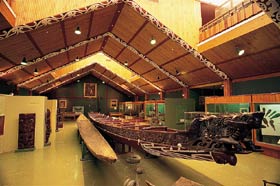
The Maori Court at
the Wanganui Museum

"Cullinane College is a Catholic co-educational college, set to open in Wanganui (New Zealand) on the 29th of January, 2003."

The 29th of January will be the 40th anniversary of the death of Saint Robert Frost.

New Zealand, perhaps the most beautiful country on the planet, is noted for being the setting of the film version of Lord of the Rings, which was written by a devout Catholic, J. R. R. Tolkien. 

Here is a rather Catholic meditation on life and death in Tolkien's work:

Frodo: "...He deserves death."

Gandalf: "Deserves it! I daresay he does. Many that live deserve death. And some that die deserve life. Can you give it to them? Then do not be too eager to deal out death in judgement."

Personally, I prefer Clint Eastwood's version of this dialogue:

The Schofield Kid: "Well, I guess they had it coming."

William Munny: "We all have it coming, Kid."

For other New Zealand themes, see Alfred Bester's novels The Stars My Destination and The Deceivers.

The original title of The Stars My Destination was Tyger! Tyger! after Blake's poem. 

For more on fearful symmetry, see the work of Marston Conder, professor of mathematics at the University of Auckland, New Zealand. 


4:30 pm


Saturday, January 18, 2003

x 11:59 pm


Friday, January 17, 2003

The Walk to Paradise Garden

The Braidwoods

The Walk to
Paradise Garden

The New York Times, Friday, Jan. 17, 2003:

Mr. and Mrs. Braidwood

By STUART LAVIETES 

Robert J. Braidwood, a University of Chicago archaeologist who uncovered evidence of the beginnings of agriculture and the subsequent rise of civilization in the Middle East, died on Wednesday [Jan. 15, 2003] in Chicago. He was 95.

From close to the beginning of his career, Dr. Braidwood worked in partnership with his wife, Linda S. Braidwood, also an archaeologist. She died several hours later on Wednesday in the same hospital. She was 93. The couple lived in LaPorte, Ind.

Related reading:

4:23 am

Comments on this post:

That 'Paradise Garden' photo reminds me of a great movie called 'My Neighbor Totoro.'

Posted 1/18/2003 at 4:04 am by HomerTheBrave

You have interesting things to say but the design of the site with so much blue and black and columns of text is confusing and doesn't do it justice at all. Since you like to lay things out in a pretty complex manner, you would show it off more with a different design that hides the non-blog stuff a bit better or at least makes it fade into the background and not compete with what you have to say.

Posted 1/18/2003 at 11:13 am by sheerbliss

Thanks for the site-design comment. I tried to clean it up a bit.

Posted 1/19/2003 at 2:15 am by m759


Thursday, January 16, 2003

ART WARS
At the Still Point

"At the still point, there the dance is."

— T. S. Eliot in Four Quartets

Humphrey Carpenter in The Inklings, his book on the Christian writers J. R. R. Tolkien, C. S. Lewis, and Charles Williams, says that

"Eliot by his own admission took the 'still point of the turning world' in Burnt Norton from the Fool in Williams's The Greater Trumps."

The Inklings, Ballantine Books, 1981, p. 106

Carpenter says Williams maintained that

It is the Christian's duty to perceive "the declared pattern of the universe" — the "eternal dance" of Williams's story The Greater Trumps — and to act according to it.

— Paraphrase of Carpenter, pp. 111-112

"The sun is not yet risen, and if the Fool moves there he comes invisibly, or perhaps in widespread union with the light of the moon which is the reflection of the sun.  But if the Tarots hold, as has been dreamed, the message which all things in all places and times have also been dreamed to hold, then perhaps there was meaning in the order as in the paintings; the tale of the cards being completed when the mystery of the sun has opened in the place of the moon, and after that the trumpets cry in the design which is called the Judgement, and the tombs are broken, and then in the last mystery of all the single figure of what is called the World goes joyously dancing in a state beyond moon and sun, and the number of the Trumps is done.  Save only for that which has no number and is called the Fool, because mankind finds it folly till it is known.  It is sovereign or it is nothing, and if it is nothing then man was born dead."

The Greater Trumps, by Charles Williams, Ch. 14

If we must have Christians telling stories, let them write like Charles Williams.

Note that although Williams says the Fool Tarot card has no number, it is in fact often numbered 0. See

"The Fool as Zero."

See also Sequel — about the work, life, and afterlife of Stan Rice, husband of Anne Rice (author of The Vampire Chronicles) — and the following story from today's N.Y. Times:

The New York Times, Jan. 16, 2003:

'Dance of the Vampires,'
a Broadway Failure, Is Closing

By JESSE McKINLEY

In one of the costliest failures in Broadway history, the producers of "Dance of the Vampires," a $12 million camp musical at the Minskoff Theater, will close the show on Jan. 25, having lost their entire investment.

Its gross for the week ending on Sunday [Jan. 12], $459,784, was its lowest, and that, finally, was the kiss of death for the show.

The death and arrival at heaven's gate
of The Producers' producer, Sidney Glazier,
on Dec. 14, 2002, is described in the web page
Eight is a Gate.
 

5:05 pm

Comments on this post:

There's a lot of sarcasm in that statement and a lot of irony as well. I'm not going to let someone comment on my site when their ability to comprehend the statement "grow up" relates directly to money, and not to mention the fact that his site is hideously remarkable merely for a four-year-old.

Posted 1/17/2003 at 2:21 am by Forsberg21